Tuesday, September 10, 2013

Careers


Science Teacher
Wildlife Biologist
Aquaculture
           
            There are many jobs to pursue when you are young, but what about the science occupations. Science can be broken into many subtopics, which leads to many jobs. So many different choices like, Wildlife Biologist, Wildlife Ecologist, Entomologist, Restoration Worker, Waste Water Manager, Aquaculture, or a Science Teacher. Today I will inform you of three; a Science Teacher, Wildlife Biologist, and Aquaculture.
            A Science teacher is someone who inspires kids to learn about science or nature. If no one informed us, we would not learn any of this information. They help us become knowledgeable about a certain topic. Honestly, without Science teachers we would be doomed. A person who is passionate about wildlife and animals could become a Wildlife Biologist. They study the behaviors of various water-loving animals. This includes the study of that organism’s structure, functioning, evolution, and interrelationships. If these biologists didn’t exist we wouldn’t know how animals behave in their natural state, how they react to things we do, or the evolution that occurs. Maybe the person is interested in Aquaculture though. Aquaculture is the farming of aquatic organisms, or the growing of fish for humans to eat. It provides for many jobs and food to eat. Not only is it big for our economy, but it also helps better our environment by filtering the water. Thus making our water conditions better, which help the animal and plant life affected by it.
            All jobs have an impact on our environment and economy. Science in particular is a major part of the world that we just can’t ignore. We will always need to know about or environment and the nature. 

Monday, September 9, 2013

Ecological Succession


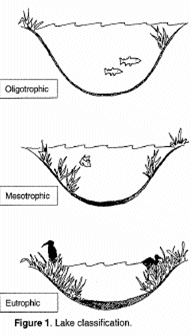
Ecological Succession is the gradual process of change in an ecosystem brought about by the progressive substitution of one community by another until stability is maintained. These three terms, oligotrophic, mesotrophic, and eutrophic, are related to this change. Oligotrophic is relatively low in plant life nutrients and contains a plethora of oxygen in deeper parts of lakes. However, mesotrophic is a lake or pond with moderate amounts of dissolved nutrients. Eutrophic is different though, it has a dense plant population and rich in nutrients. These three terms are significant in freshwater ecology because as the lakes age, the ecology changes. The oligotrophic is the youngest stage or age, mesotrophic is middle aged, and eutrophic is the oldest stage of a body of water. They are important to learn and know because they can help ecologists determine the age of a body of water by determining if it is one of the three.
In my aquarium, it would be thought of as oligotrophic while Lake Lewisville would be considered mesotrophic. All bodies of water are different and change due to succession. It’s really beneficial if you could use these terms to classify your lake, pond, aquarium, etc.

Friday, September 6, 2013

Freshwater Ecology


Freshwater Ecology is a term used for the study of interrelationships between freshwater organisms and their natural environment. Not only is it the study of their environment, it also goes in depth about how the organism reacts and is affected by their habitat. By learning about plants and animals in the body of water as well as the system of the water itself, a scientist majoring in freshwater ecology can discover valuable information about the health and needs of a freshwater structure. The information that freshwater ecologists can collect is beneficial to conservation efforts and data that affect humans too.
This ecology study includes bodies of water, such as lakes, ponds, and rivers. Rivers and ponds might have similarities like freshwater, but there are differences too. A pond is a little circle of water that doesn’t lead to a bigger body of water, whereas a river does lead to the sea or ocean. A pond is part of the lentic system that has defined boundary lines and divided into three major zones. A river is part of the lotic system characterized by flowing water and currents. A pond is also defined by light penetrating to the bottom, whereas a river is based on the quickness of water. No matter what body of water it is, it’s still part of freshwater ecology.


Thursday, September 5, 2013

Water Issue Presentations


            The water issue presentations were quite interesting. Some of them I learned facts that I did not know before this class. I learned that only one percent of water is available for human use. That is mind blowing because out of all the water on this Earth, only that tiny amount is for our usage. What amazed me though is that a toilet uses 6.5 gallons of water for one flush. Imagine 6.5 milk jugs being flushed down the toilet because that’s how much it uses. Those two facts were over the conservation of water and they said to be useful of the water we have, not waste it. I also learned that steak consists of more water than salad because 98 percent of water use is consumption. Besides those facts, I discovered that Marcus used 51,750 gallons of water a day last year. Not only does Marcus use that much water, but also they have 16 meters on campus for irrigation and domestic use.
            All the presentations had informational filled slides that were fascinating. Even though they were all great, I personally thought the zebra mussels was the best. I learned what a zebra mussel was, along with how they made it to lake Lewisville. It’s because of the Trinity River incase you were wondering. They also had photos of them having fun which made it worth paying attention. Besides, the presenters were funny as well.
            Looking back at my presentation with my partner, we could’ve done things differently. I think we did a good job of explaining how prescription drugs affect water and lake organisms. Not only did we do this, but we also gave background information on how the pharmaceuticals made their way to contaminate water. We met all the requirements I feel like, even with our pictures where we weren’t afraid to be dorks. I do feel like we could have done a better job in the final step of presenting the information though. We just read off a screen for the power point and I feel like we could’ve improved. That’s in the past though and I believe we still did well. 

Wednesday, September 4, 2013

Aquarium Progress


            My aquarium is doing well so far. It has only been a couple of days, less than a week, since we have set it up. The water is crystal clear with no particles or dirty water in it. Clean water also means a fantastic filter that is working well. I know it is working because the water runs out like it should and there are bubbles. There are no decorations floating in the water, they are in the gravel like they should. Along with all of that doing well, the gravel still looks clean from when we washed it.
Although it seems to look good, we did some tests just to make sure.  The temperature is not too hot or cold, 82 degrees Fahrenheit, is a nice environment for the aquatic life to live. Now it is time for the ammonia and nitrate tests to conclude the information needed in order to put the fish in the tank. My aquarium’s results were relatively close to the perfect results. The ammonia sample turned a yellow-green color, an acceptable result, to reach a 0.25ppm. Since this was an acceptable level, I did not have to make changes to the tank. Then came the nitrate test that I followed to the tee and my results reflected it. The final color was a yellow-orange at a level of 5ppm. The acceptable level was below 40ppm, so my group was well under. Next thing we did was a chlorine, hardness, alkalinity, and pH test. The results compared to the color key was; chlorine of 0ppm, hardness of 250ppm, alkalinity of 240ppm, and a pH of 7.8.
            All of the test results were acceptable; therefore we changed nothing about our tank. The perfect results meant that we could purchase our fish for the aquarium. The fish would be able to live in the tank water due to the levels being what they are supposed to be. There was no chlorine in the water so the fish would not die. Aquatic life would thrive in the aquarium because our water was the environment needed for it. Our results mean it will be easy for the fish to be acclimated to the tank. 

Tuesday, September 3, 2013

Ammonia and Nitrate Tests


In order to conduct an Ammonia test, first hook the thermometer onto the tank and record the temperature. Draw 5mm of water from the aquarium into a test tube. With the two Ammonia bottles, take the first bottle and add 8 drops to the test tube sample. Then take the second bottle and add 8 drops into the test tube sample as well. Put cap on the test tube, and gently swirl the mixture. Next let the solution sit for 5 minutes, then compare the water’s color to the color-coded sheet. The desired color is a yellow and .25ppm is acceptable. If the water is not up to standards, add more bacteria supplement to the aquarium.
            To complete a Nitrate test, first check the water temperature of the aquarium with a thermometer, and record. Then draw 5mm of water into a test tube from the aquarium. Using the two Nitrate bottles, take the first bottle and add 10 drops to the sample and swirl in the chemicals. Next, take the second bottle and shake it for 30 seconds, and then add 10 drops into the water sample. Swirl the mixture for a minute, and then compare the water’s color to the card. The color should be a yellow-orange color and have a level of 40 or below. If the water is not acceptable, add plants to the aquarium or clean the rocks.
            Ammonia can enter the aquarium through three different ways. The first way for ammonia to enter the water is through tap water that has been treated with chloramine. The second way is though the decomposition of organisms inside the aquarium causing a build up of proteins and ammonia. The third and final way that ammonia enters the aquarium is through the digestion of protein in fish, which is later released into the water through the gills. Ammonia is a toxin and therefore harmful to the fish if the levels are not kept at zero. The ammonia irritates the gills of the fish, causing the gills to thicken and clump together, resulting in less oxygen intake.
            One main cause of high nitrate levels in an aquarium is due to the overfeeding of fish. This is due to the fact that if the fish does not digest the food within ten minutes, the uneaten food will begin to decay at the bottom of the tank and release nitrate. Another cause of high nitrate is the nitrate already in the tap water while changing the water. The third increase in nitrate levels is the use of plant fertilizer, and finally the decay of organisms. With increase in nitrate levels, the fish will become sick and start to die. The fish will become sick because of stress and the immune system will become weaker overtime if the water is not changed.

Monday, September 2, 2013

Observation, Inferences, and Options

An observation is paying attention to your surroundings and recording what is seen. An inference is a conclusion reached by evidence and reasoning. An opinion is a personal view or judgment, not necessarily based on facts and knowledge.

In the fish tank, there is a school of five fish swimming throughout the tank. Three of the fish are a white and deep green color, while the other two fish are an orange and white color. An inference of the aquarium is that the plants in the tank release oxygen into the water for the fish to breathe. The fish seem content with their living situation due to the fact that they have enough plants to provide a significant amount of oxygen, the environment has enough decoration to swim around in, and they have each other for company.
A good observation starts with an initial hypothesis. After coming up with a hypothesis, concisely write down everything you see from changes in appearances, masses or percent yield, and things that go wrong. A good observation is important because it explains what happens, allowing the hypothesis to be answered. Without an observation, a scientific conclusion cannot be found.
Inferences and options have a place in science due to the fact that they are the bases to questions and hypothesis in science. Without having opinions on the outside world, questions like Sir Isaac Newton’s on gravity would never had been answered. Inferences give backing to opinions, like the apple falling from the tree in Newton’s experiment.